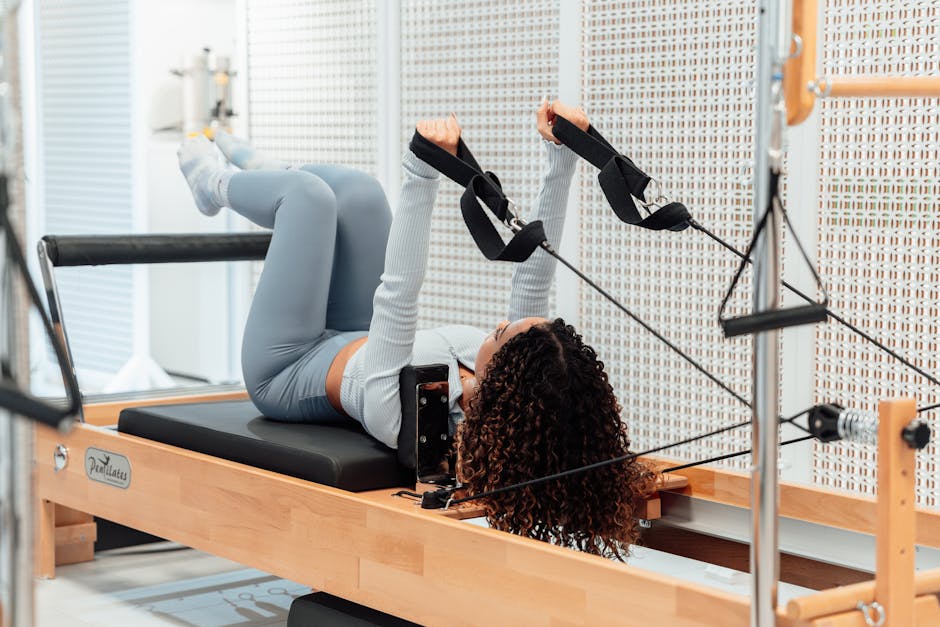
Right now, your shoulders are probably creeping forward and your lower back is starting to ache. I can say that with confidence because I spent years in the same position, hunched over my keyboard, dealing with the aftermath of a 2012 back injury that desk work made steadily worse.
After trying everything from ergonomic chairs to physical therapy sessions, I discovered that pilates exercises for posture addressed something the other approaches missed: the deep core weakness and movement dysfunction that kept pulling me back into poor alignment. Your body wasn’t designed to spend 8+ hours folded into a chair, and pilates gives you the tools to fight back effectively.
I’m not talking about quick stretches that provide temporary relief. Pilates builds the foundational strength and body awareness you need to maintain proper alignment naturally, without constantly reminding yourself to sit up straight. After two years of working with this approach, I can tell you it works differently than anything else I tried.
Key Takeaways
Pilates exercises for posture target core weakness, spinal stiffness, and posterior chain imbalances that cause desk worker pain
The mind-body connection in pilates helps desk workers develop postural awareness that prevents slouching throughout the workday
Specific movements like Half Roll Back, Swan Prep, and Shoulder Bridge directly counteract forward head posture and rounded shoulders
Regular pilates practice builds deep core stability that supports your spine without conscious effort
Spinal mobility exercises restore natural curves and reduce compression from prolonged sitting
Why Pilates Works Better Than Traditional Exercise for Desk Workers
Most fitness approaches treat symptoms rather than causes. You might strengthen your back muscles at the gym, but if your deep core remains weak and your movement patterns stay dysfunctional, you’ll return to your desk and immediately revert to poor posture. I learned this the hard way after months of deadlifts and rows that didn’t translate to better desk posture.
Pilates exercises for posture work differently. This method addresses the root causes of desk worker pain by targeting three areas that traditional workouts often miss: deep core stability, spinal mobility, and postural awareness. When these elements work together, your body naturally maintains better alignment without constant conscious effort.
The controlled, precise movements in pilates also mirror the mindful attention needed to maintain good posture throughout your workday. You’re not just building muscle, you’re training your nervous system to recognize and correct postural deviations before they become painful problems.
I found that pilates emphasizes quality over quantity. A 20-minute focused session was more effective than an hour of mindless repetitions because every movement is performed with intention and proper form. This efficiency matters when you’re already spending long days at work.
The Core-Posture Connection: Building Your Body’s Natural Support System
Your core isn’t just your “six-pack” abs. It’s a complex system of deep muscles that includes your diaphragm, pelvic floor, transverse abdominis, and multifidus. These muscles work together to create internal pressure that supports your spine and maintains proper alignment.
When you spend hours in a chair, these deep core muscles essentially “turn off.” Your body compensates by overusing surface muscles, leading to the tight shoulders, forward head posture, and lower back pain that I dealt with for years. Pilates exercises for posture specifically reactivate and strengthen these deep stabilizers.
How Core Weakness Creates Postural Problems
Without adequate core support, your spine loses its natural curves. Your pelvis tilts, your ribcage shifts forward, and your head protrudes ahead of your shoulders. This creates a cascade of compensations that ripple throughout your entire body. I noticed this pattern clearly in photos of myself at my desk over the years.
The beauty of pilates core work is that it teaches you to maintain this internal support while moving and breathing naturally. You’re not holding your breath or creating artificial tension. You’re learning to engage these muscles functionally, the way they’re meant to work during daily activities.
The Breath-Posture Partnership
Pilates breathing patterns directly improve posture by teaching you to engage your core while maintaining mobility in your ribcage and spine. This coordinated breathing helps reset your nervous system and reduces the stress-related tension that contributes to poor posture.
When you breathe properly, your diaphragm and pelvic floor work in harmony, creating the internal stability that allows your spine to lengthen and your shoulders to relax. This is why pilates exercises for posture feel so different from other forms of exercise. You’re working with your body’s natural systems rather than against them.
Essential Pilates Exercises for Posture Transformation
The following movements specifically address the muscular imbalances and movement restrictions that develop from prolonged desk work. Each exercise targets multiple aspects of postural dysfunction while building the strength and awareness needed for lasting change.
Half Roll Back: Building Posterior Chain Control
The Half Roll Back directly counters the forward collapse that occurs during desk work. This exercise strengthens your deep abdominals while teaching controlled spinal flexion and extension—movements that become restricted from prolonged sitting. I do this one every morning because it immediately reminds my spine how to move properly.
Sit tall with knees bent, feet flat on the floor, arms extended forward at shoulder height
Engage your deep core and slowly roll your spine backward, one vertebra at a time, until you feel your abdominals working
Hold this position for 3 breaths, maintaining the C-curve of your spine
Slowly roll back up to sitting, leading with your head and allowing your spine to rebuild its natural curves
Repeat 5-8 times, focusing on smooth, controlled movement
This movement teaches you to use your deep core muscles to control spinal movement, which directly transfers to better postural support when sitting at your desk. The control aspect is key—you’re training precision, not just strength.
Swan Prep: Reversing Forward Head Posture
Swan Prep is one of the most effective pilates exercises for posture because it directly counteracts the rounded shoulders and forward head position that develop from computer work. This exercise strengthens your posterior chain while improving spinal extension. I noticed significant improvement in my forward head posture after about 4 weeks of consistent practice.
Lie face down with your forehead resting on your hands, elbows wide. Press your pubic bone into the mat to engage your deep abdominals, then slowly lift your head and chest, using the muscles between your shoulder blades rather than pushing with your arms. Hold for 3 seconds, then lower with control.
The key is to initiate the movement from your upper back muscles, not your lower back. This teaches your body to extend through the thoracic spine, which is often locked in flexion from hunching over a computer. Get this wrong and you’ll feel it in your lower back instead of between your shoulder blades.
Shoulder Bridge: Activating the Posterior Chain
Desk workers often develop weak glutes and tight hip flexors, which contribute to lower back pain and poor posture. The Shoulder Bridge exercise reactivates these important postural muscles while improving hip mobility. This was a game-changer for my lower back pain.
Lying on your back with knees bent, slowly peel your spine off the mat one vertebra at a time, leading with your tailbone. At the top, your body should form a straight line from knees to shoulders. Focus on engaging your glutes and hamstrings rather than overusing your lower back muscles.
This exercise teaches you to use your glutes for hip extension, which helps maintain proper pelvic alignment when standing and walking. Strong glutes also provide crucial support for your lower back during prolonged sitting. The sequential movement pattern is what makes this different from a regular glute bridge.
Swimming: Coordinating the Entire Posterior Chain
The Swimming exercise challenges your entire posterior chain while improving coordination between your arms, legs, and core. This full-body integration is essential for maintaining good posture during complex daily activities. It’s harder than it looks and requires significant concentration.
Lying face down, extend your arms overhead and legs straight. Engage your core to lift your head, chest, arms, and legs off the mat. Alternate lifting opposite arms and legs in a swimming motion, maintaining steady breathing throughout the movement.
Swimming teaches you to maintain core stability while moving your limbs independently—a skill that directly translates to better posture when reaching, typing, or performing other work-related movements. Start with shorter holds (10-15 seconds) and work up to longer durations.
Spinal Mobility: Restoring Natural Movement Patterns
Prolonged sitting creates stiffness throughout your spine, particularly in the thoracic region. This loss of mobility forces other areas to compensate, leading to pain and dysfunction. I discovered that my mid-back was essentially locked in flexion from years of computer work, which forced my neck and lower back to overcompensate.
Spinal mobility work in pilates isn’t just about flexibility. It’s about restoring the dynamic stability that allows your spine to move efficiently while maintaining proper alignment. This combination of mobility and stability is what separates pilates from passive stretching approaches.
The controlled movements in pilates help decompress your spine while teaching you to move from your core rather than forcing movement through restricted areas. This approach gradually restores natural movement patterns without creating instability or injury. Progress is measured in weeks and months, not days.
The Mind-Body Connection: Why Awareness Matters More Than Strength
The most powerful aspect of pilates exercises for posture isn’t just the physical strengthening. It’s the development of proprioceptive awareness. This mind-body connection helps you recognize postural deviations before they become painful problems. I started noticing when I was slouching within the first two weeks of consistent practice.
Traditional workouts often encourage you to “push through” or ignore what your body is telling you. Pilates takes the opposite approach, teaching you to tune into subtle sensations and make micro-adjustments that prevent larger problems from developing.
Developing Postural Awareness at Work
The concentrated focus required during pilates practice trains your nervous system to maintain awareness of your body position throughout the day. You begin to notice when your shoulders creep up toward your ears or when your head drifts forward, allowing you to make corrections before discomfort sets in.
This awareness doesn’t happen overnight, but consistent practice with pilates exercises for posture gradually rewires your postural reflexes. You stop relying on external reminders and develop an internal sense of what good posture feels like. This took about 6-8 weeks for me to develop reliably.
The Concentration Factor
Unlike mindless repetition exercises, every pilates movement requires focused attention. This concentration aspect is particularly beneficial for desk workers who often operate on autopilot, allowing poor postural habits to develop unconsciously.
The mental focus required in pilates creates a meditative quality that helps reduce stress—a major contributor to muscle tension and poor posture. This dual benefit of physical strengthening and stress reduction makes pilates uniquely effective for addressing desk worker challenges.
Building a Sustainable Practice for Long-Term Results
Consistency beats intensity when it comes to postural transformation. A brief 15-20 minute daily practice of pilates exercises for posture will create more lasting change than sporadic hour-long sessions. I learned this after trying to cram longer sessions into my schedule and burning out after three weeks.
Start with 2-3 exercises performed with precision and gradually add movements as your strength and awareness develop. Focus on quality over quantity. It’s better to perform five perfect movements than twenty sloppy ones. I started with just the Half Roll Back and Swan Prep for two weeks before adding other exercises.
Remember that postural change is a process, not a destination. Your body has spent years developing compensatory patterns, so be patient as you retrain these deeply ingrained habits. Small, consistent improvements compound into significant transformations over time.
Integration is key. The goal isn’t just to have good posture during exercise, but to carry these improvements into your daily work life. Practice engaging your core and maintaining spinal length during simple activities like walking to the coffee machine or sitting down at your desk.
Frequently Asked Questions
How often should I do Pilates exercises to see improvement in my posture and back pain?
For optimal results, aim to practice Pilates exercises for posture 3-4 times per week, with each session lasting 20-30 minutes. Consistency is more important than duration—regular shorter sessions will be more effective than sporadic longer workouts. You may notice improved awareness and reduced tension within the first week, while significant postural changes typically develop over 4-6 weeks of consistent practice.
Can I do these Pilates exercises at my desk during work breaks?
While some modified versions can be done at your desk, most effective Pilates exercises for posture require floor space and proper body positioning. The Half Roll Back can be adapted to sitting, and breathing exercises work well at your desk. However, exercises like Swan Prep and Shoulder Bridge need to be done on the floor to properly target the deep stabilizing muscles and reverse postural imbalances.
Why do my shoulders and neck feel tighter after starting Pilates exercises?
Initial muscle soreness or tightness is normal as your body begins activating dormant deep muscles and changing long-held postural patterns. Your nervous system is learning new movement patterns, which can create temporary tension as muscles that have been overworking begin to relax and underused muscles start engaging. This typically resolves within 1-2 weeks as your body adapts to proper alignment.
What's the difference between Pilates core work and regular ab exercises for fixing posture?
Traditional ab exercises typically focus on surface muscles like the rectus abdominis (six-pack), while Pilates targets deep core muscles including the transverse abdominis, diaphragm, and pelvic floor. These deep stabilizers create internal pressure that supports your spine naturally throughout the day. Pilates also integrates breathing patterns and spinal mobility, teaching your core to function properly during daily activities rather than just during exercise.
How long does it take to retrain my body to maintain better posture automatically?
Developing automatic postural awareness through Pilates typically takes 6-12 weeks of consistent practice. The nervous system needs time to create new neural pathways that support better alignment without conscious effort. You'll notice improved awareness within the first few weeks, but lasting postural changes that feel natural and effortless usually require 2-3 months of regular practice as your deep stabilizing muscles strengthen and your movement patterns become ingrained.
The Bottom Line
Pilates exercises for posture offer desk workers a scientifically-backed path to lasting relief from back pain and postural dysfunction. Unlike quick fixes that merely treat symptoms, pilates addresses the root causes by building core strength, restoring spinal mobility, and developing the postural awareness needed to maintain proper alignment throughout your workday.
The mind-body approach of pilates creates lasting change by rewiring your movement patterns and postural reflexes at the neurological level. This means you’re not just temporarily stronger—you’re changing how your body holds itself and moves through space.
Start today by incorporating the Half Roll Back into your morning routine. This single exercise will begin building the core awareness and posterior chain strength that forms the foundation of better posture. Based on my experience, you’ll notice the difference within the first week.
Watch: Pilates for Better Posture
Video courtesy of Jessica Valant PT
Products Mentioned in This Article
As an Amazon Associate, I earn from qualifying purchases. These links help support the site at no extra cost to you.